Net zero: A prosperous, fair and strong Victoria
Victoria's Climate Change Strategy 2026–30 (PDF, 4.3 MB) focuses on what matters to Victorians and is backed by over $8.5 billion. This builds on the almost $2 billion that was announced with the Climate Change Strategy 2021–25.
The strategy is shaped by Victorians – with over 500 submissions from organisations and individuals guiding the government's actions and priorities.
It sets up the next phase of the government’s climate action that benefits the Victorian economy and community.
Victoria’s climate action for the next 5 years is based on 4 priorities:
- helping households with the cost of living and lowering costs for business
- building for the future
- putting jobs and workers first in the transition
- protecting kids, families and communities.
The Victorian Government is delivering results
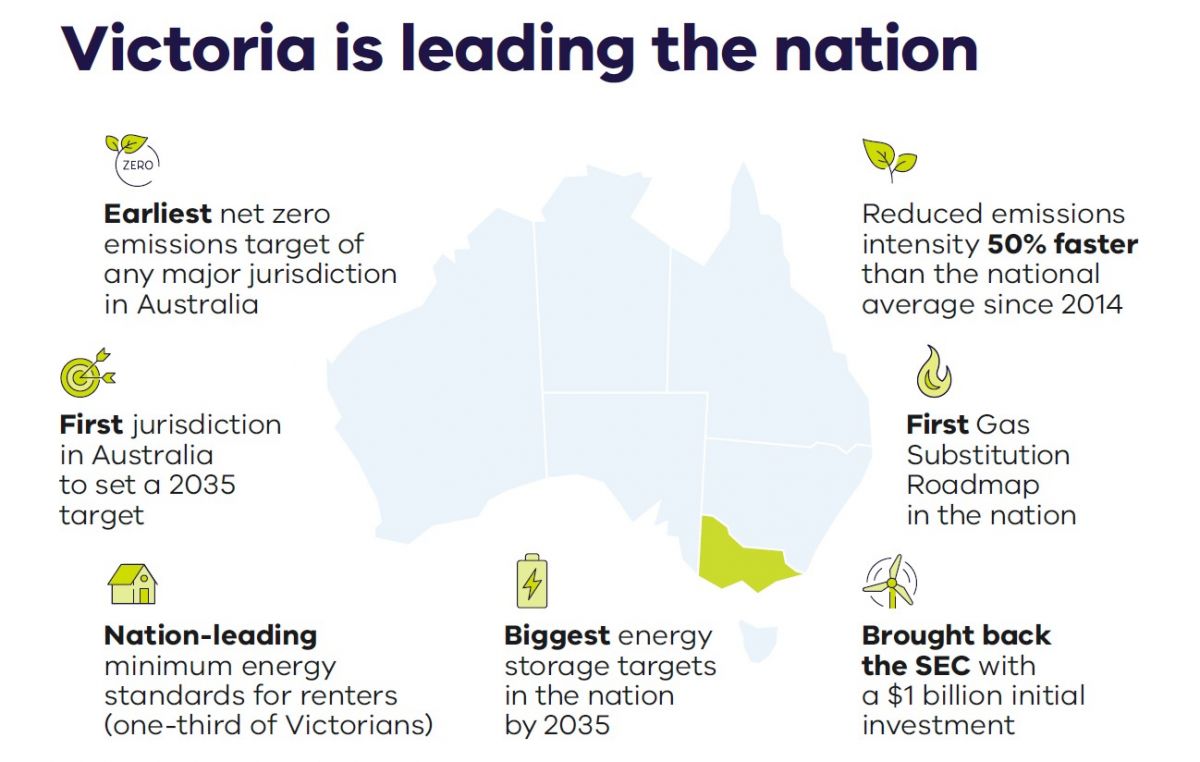
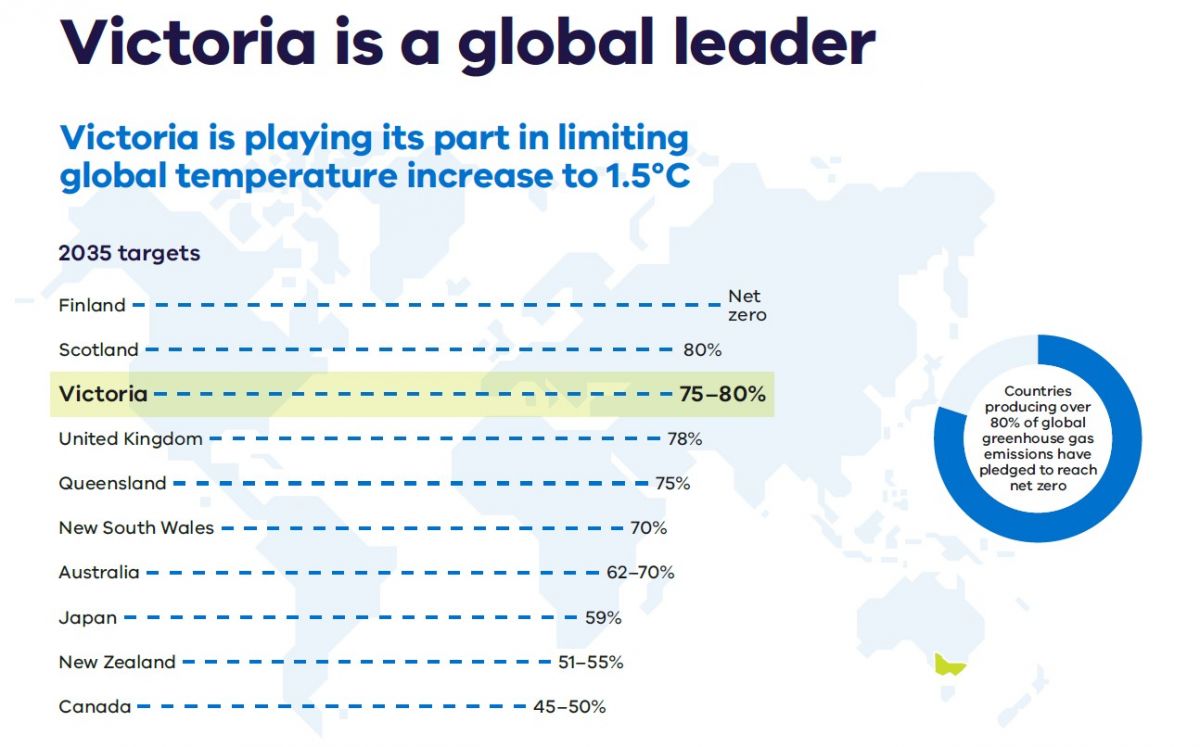
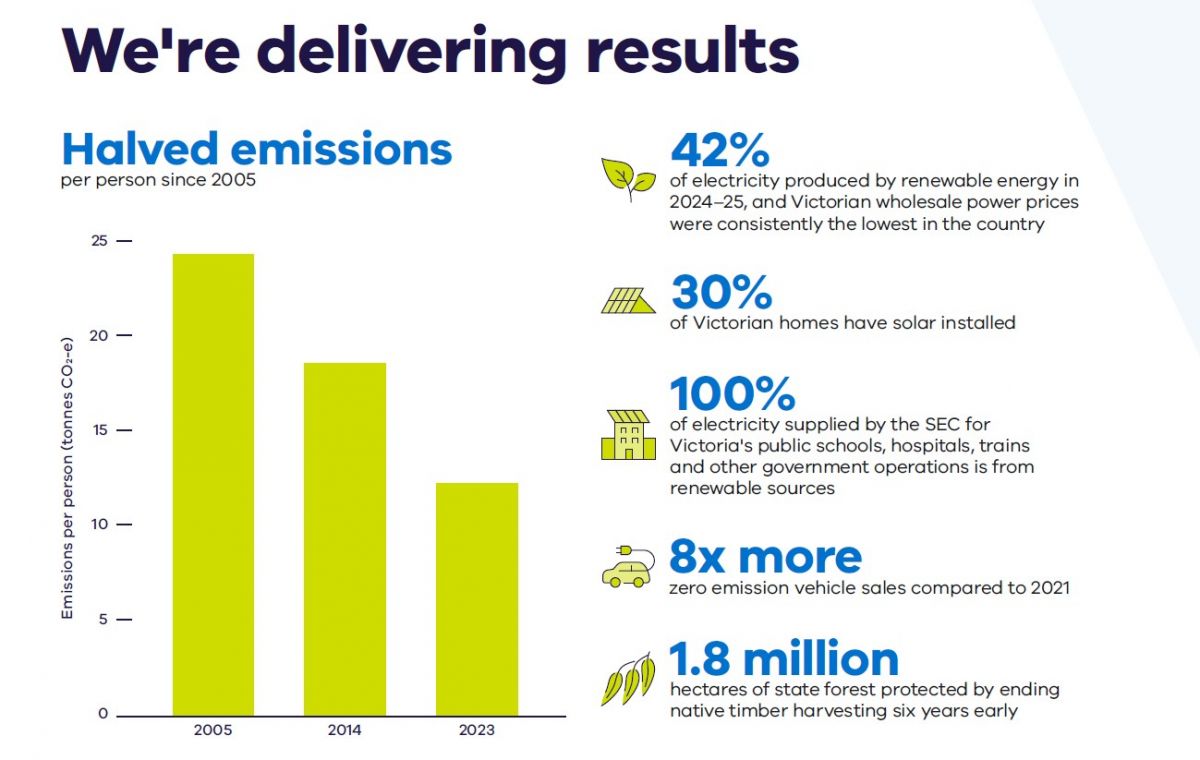
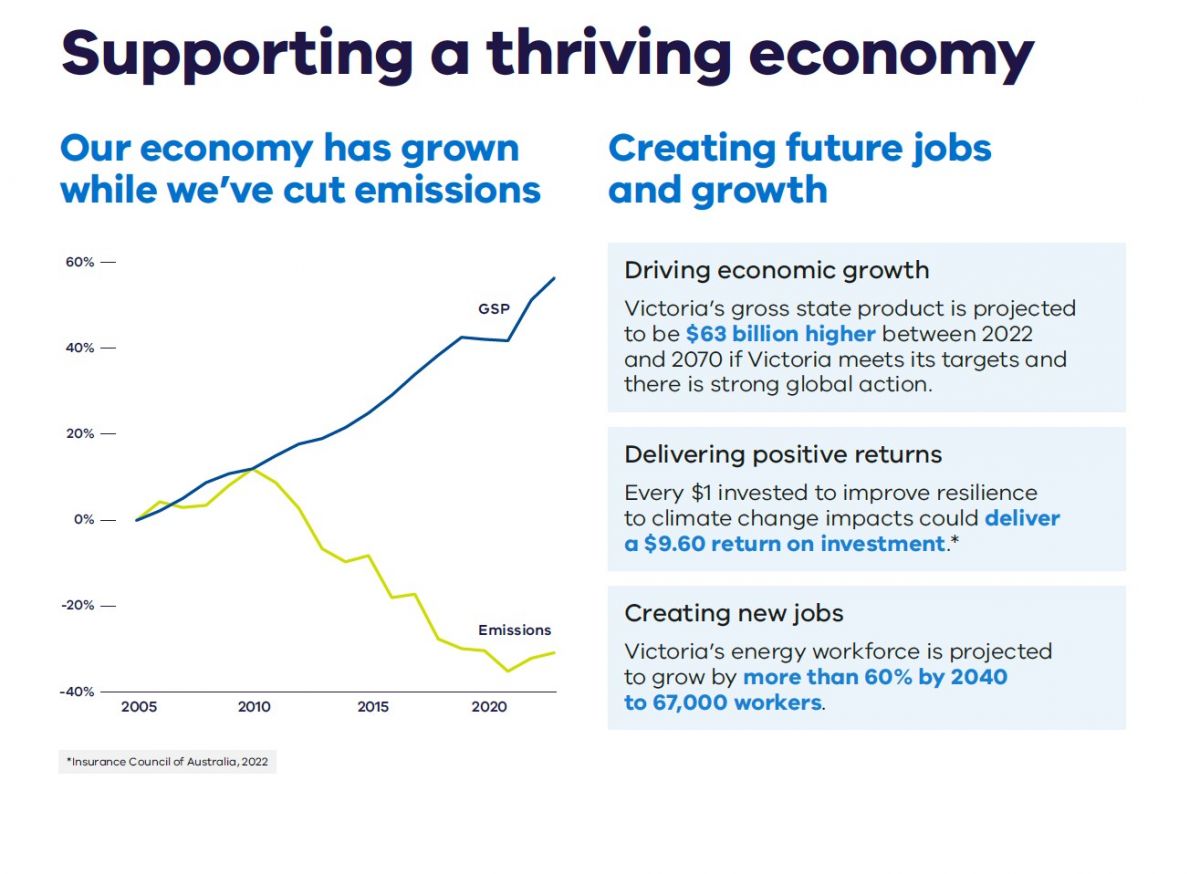
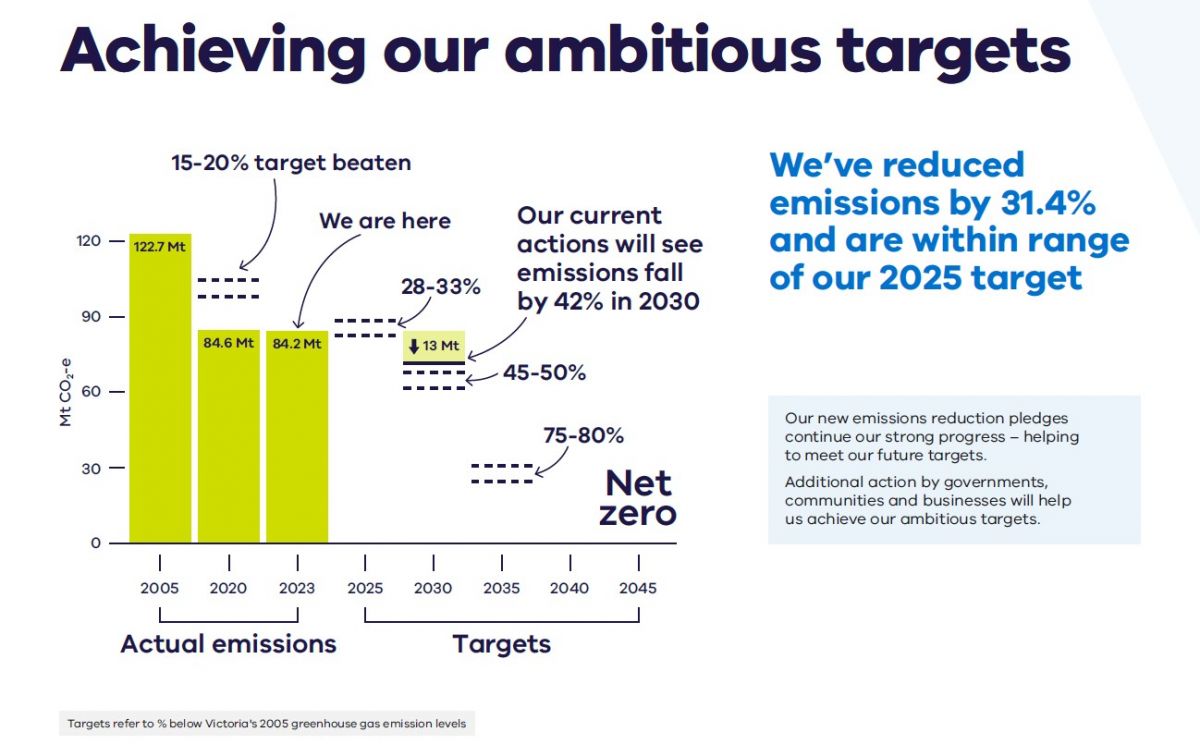
Image 1
- Earliest net zero emissions target of any major jurisdiction in Australia
- First jurisdiction in Australia to set a 2035 target
- Nation-leading minimum energy standards for renters (one-third of Victorians)
- Reduced emissions intensity 50% faster than the national average since 2014
- Brought back the SEC with a $1 billion initial investment
- First Gas Substitution Roadmap in the nation
- Biggest energy storage targets in the nation by 2035
Image 2
Victoria is playing its part in limiting global temperature increase to 1.5°C
2035 targets
- Finland: Net zero
- Scotland: 80%
- Victoria: 75-80%
- United Kingdom: 78%
- Queensland: 75%
- New South Wales: 70%
- Australia: 62-70%
- Japan: 59%
- New Zealand: 51-55%
- Canada: 45-50%
Countries producing over 80% of global greenhouse gas emissions have pledged to reach net zero.
Image 3
The bar chart shows emissions per person halved from 2005 (24.58 tonnes CO2-e) to 2003 (12.35 tonnes CO2-e).
- 42% of electricity produced by renewable energy in 2024–25, and Victorian wholesale power prices were consistently the lowest in the country
- 30% of Victorian homes have solar installed
- 100% of electricity supplied by the SEC for Victoria's public schools, hospitals, trains and other government operations is from renewable sources
- 8x more zero emission vehicle sales compared to 2021
- 1.8 million hectares of state forest protected by ending native timber harvesting six years early
Image 4
Our economy has grown while we’ve cut emissions
The chart shows that GSP increased by 57.5% from 2005 to 2023, while emissions fell 31.4% from 2005 to 2023.
Creating future jobs and growth
Driving economic growth
Victoria’s gross state product is projected to be $63 billion higher between 2022 and 2070 if Victoria meets its targets and there is strong global action.
Delivering positive returns
Every $1 invested to improve resilience to climate change impacts could deliver a $9.60 return on investment. (Source: Insurance Council of Australia, 2022)
Creating new jobs
Victoria’s energy workforce is projected to grow by more than 60% by 2040 to 67,000 workers.
Image 5
We’ve reduced emissions by 31.4% and are within range of our 2025 target.
The chart shows Victoria's greenhouse gas emission reduction targets below 2005 levels – 2020: 15-20%; 2025: 28-33%; 2030: 45-50%; 2035: 75-80%, and; net-zero by 2045.
The chart details historic greenhouse gas emissions in Victoria – 2005: 122.7 Mt CO₂-e; 2020: 84.6 Mt CO₂-e; 2023: 84.2 Mt CO₂-e. Data shows that we beat our 2020 target of 15-20% below 2005 levels.
The chart also shows that current actions will see Victoria’s emissions fall an additional 13 Mt CO₂-e by 2030, equivalent to 42% below 2005 levels.
Our new emissions reduction pledges continue our strong progress – helping to meet our future targets.
Additional action by governments, communities and businesses will help us achieve our ambitious targets.
Emissions reduction pledges will cut emissions across sectors
The Victorian Government’s emissions reduction pledges for 2026-30 detail actions to reduce emissions and drive innovation across the economy.
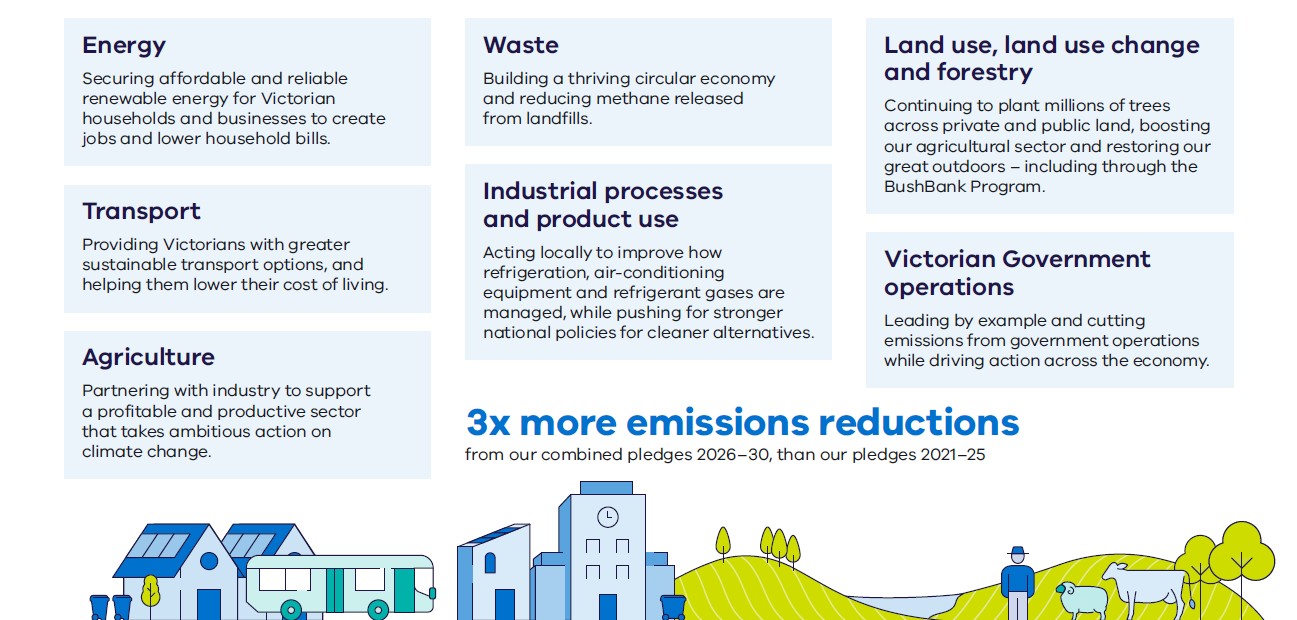
Energy: Securing affordable and reliable renewable energy for Victorian households and businesses to create jobs and lower household bills
Transport: Providing Victorians with greater sustainable transport options and helping them lower their cost of living.
Agriculture: Partnering with industry to support a profitable and productive sector that takes ambitious action on climate change.
Waste: Building a thriving circular economy and reducing methane released from landfills.
Industrial processes and product use: Acting locally to improve how refrigeration, air-conditioning equipment and refrigerant gases are managed, while pushing for stronger national policies for cleaner alternatives.
Land use, land use change and forestry: Continuing to plant millions of trees across private and public land, boosting our agricultural sector and restoring our great outdoors - including through the BushBank Program
Victorian Government operations: Leading by example and cutting emissions from government operations while driving action across the economy.
3x more emissions reductions from our combined pledges 2026-30, then our pledges 2021-25.
You can find out more about Victorian Government action on climate change and how it is supporting local action on climate change.
Download the strategy and supporting documents
Strategy
- Victoria’s Climate Change Strategy 2026–30 (PDF, 4.3 MB)
- Victoria’s Climate Change Strategy 2026–30 - accessible (DOCX, 1.1 MB)
- Victoria's Climate Change Strategy 2026-30 Summary (PDF, 156.4 KB)
- Victoria's Climate Change Strategy 2026-30 Summary - accessible (DOCX, 51.1 KB)
Pledges
Energy pledge
- Energy sector pledge 2026–30 (PDF, 2.2 MB)
- Energy sector pledge 2026-30 - accessible (DOCX, 204.6 KB)
Transport pledge
- Transport sector pledge 2026–30 (PDF, 2.4 MB)
- Transport sector pledge 2026-30 - accessible (DOCX, 203.8 KB)
Agriculture pledge
- Agriculture sector pledge 2026–30 (PDF, 3.8 MB)
- Agriculture sector pledge 2026-30 - accessible (DOCX, 469.3 KB)
Land use, land use change and forestry pledge
- Land use, land use change and forestry sector pledge 2026–30 (PDF, 3.0 MB)
- Land use, land use change and forestry sector pledge 2026-30 - accessible (DOCX, 202.8 KB)
Waste pledge
Industrial processes and product use pledge
- Industrial processes and product use sector pledge 2026–30 (PDF, 1.9 MB)
- Industrial processes and product use sector pledge 2026-30 - accessible (DOCX, 164.0 KB)
Whole of Victorian Government pledge
Previous editions of Victoria's Climate Change Strategy and supporting documents
- Victoria's Climate Change Strategy 2021–25 (PDF, 5.7 MB)
- Victoria's Climate Change Strategy 2021–25 - accessible (PDF, 1.7 MB)
- Victoria's Climate Change Strategy 2021–25: Economic analysis (PDF, 2.9 MB)
- Victoria's Climate Change Strategy 2021–25 by Numbers (PDF, 258.0 KB)
Contact us
If you would like to get in touch or find out more, email us at climate.change@deeca.vic.gov.au.
Accessibility
To receive this document in an alternative format, phone the Customer Contact Centre on 136 186, email customer.service@deeca.vic.gov.au, or contact National Relay Service (www.accesshub.gov.au) on 133 677.
Page last updated: 22/01/26