To learn more about how Victoria contributes to global greenhouse gas emissions, refer to Victoria's greenhouse gas emissions page.
Victoria’s climate action targets
Victoria has set in law world-leading targets to cut the state’s greenhouse gas emissions and achieve net zero emissions by 2045.
The government confirmed Victoria’s newest target, for 2035, in May 2023.

Driving real climate action
Victoria's 2035 Emissions Reduction Target (PDF, 3.4 MB): Victoria’s new 2035 target and key emissions reduction policies.
Victoria's 2035 Emissions Reduction Target - accessible (DOCX, 463.8 KB): Victoria’s new 2035 target and key emissions reduction policies - accessible version.
Victoria’s climate action targets

Victoria was one of the first jurisdictions in the world to put a net-zero emissions target in law. The Government brought forward the commitment to achieve net-zero from 2050 to 2045.
Victoria beat its first target – to reduce emissions 15-20% below 2005 levels by 2020 – with a cut of almost 30%.
Building on this success, the Victorian Government has legislated interim targets that provide a clear path to net-zero emissions:
- 28-33% by 2025
- 45-50% by 2030
- 75-80% by 2035.
Victoria’s targets are all reductions below 2005 emissions levels.
Note: Victoria’s 2040 target will be set by 31 March 2028.
Benefits from climate action
Meeting Victoria’s targets will create new jobs, including in clean energy, land restoration, zero-emissions transport, and the circular economy.
It will also create significant benefits for the community and the environment including cleaner air, lower energy bills, and greater biodiversity.
Meeting Victoria’s climate action targets will benefit the economy. Victoria’s economy will be $63 billion bigger from now to 2070 with our targets and strong global climate action. Strong targets will help attract part of the estimated $US130 trillion of global private finance available for the transition to net zero emissions. The targets will also help Victoria stay competitive as our key trading partners transition to net zero emissions.

Meeting Victoria’s targets
Victoria’s targets are ambitious but achievable, building on trends and actions already underway. Victoria’s emissions have been falling since 2010. We beat the 2020 target and by 2021, Victoria’s emissions had fallen by 32% below 2005 levels.
Key actions the Victorian Government is already taking to cut emissions include:
- increasing and legislating the 2030 Victorian Renewable Energy Target (VRET) to 65% and setting a VRET new target of 95% renewable electricity generation by 2035
- legislating energy storage targets of least 2.6 gigawatts (GW) of energy storage capacity by 2030 and at least 6.3 GW by 2035 – the biggest targets in Australia
- legislating offshore wind targets of at least 2 GW of offshore generation capacity by 2032, 4 GW by 2035 and 9 GW by 2040.
- putting electricity back in the hands of Victorians by bringing back the State Electricity Commission (SEC)
- setting a target for 50% of new light vehicle sales to be zero emissions vehicles – powered by electricity, hydrogen and other clean new fuels – by 2030
- working towards the world’s first carbon-neutral pasture-based dairy farm.
The Victorian Government will continue to work with communities and businesses to build on these actions and meet the state’s climate action targets. Victoria’s Climate Action Act 2017 sets a framework to keep developing new policies to meet the targets, called sector pledges.
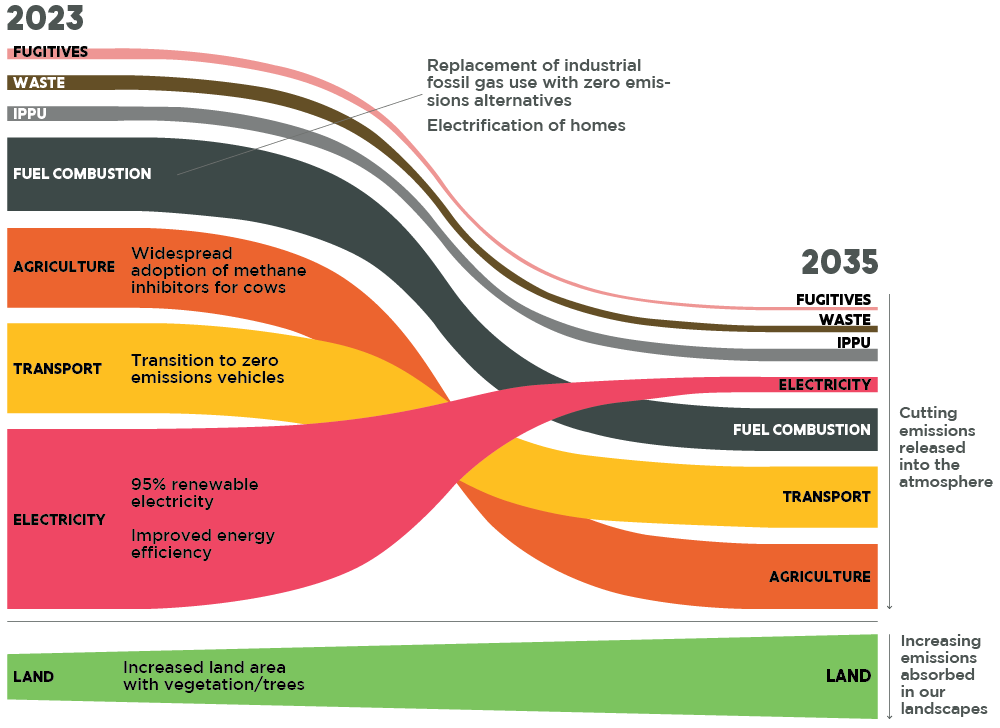
Victoria’s climate action targets can be met with known technologies and solutions – and there is more than one way to get there. By 2035, all sectors of Victoria’s economy will be on their way to net zero emissions.
Illustrative pathway and key changes from today to Victoria’s 2035 target
Want to know more?
Determination of Victoria’s 2035 target was informed by the following:
- Victoria’s 2035 Emissions Reduction Target: Supporting Analysis (PDF, 938.9 KB): a summary of the modelling exercises informing Victoria’s 2035 emissions reduction target
- Victoria’s 2035 Emissions Reduction Target: Supporting Analysis (DOCX, 552.1 KB): a summary of the modelling exercises informing Victoria’s 2035 emissions reduction target - accessible version
- Victoria’s 2035 climate action target (PDF, 5.5 MB): driving growth and prosperity: advice from the independent expert panel on Victoria’s 2035 target
- Victorian emissions budgets (PDF, 1.5 MB): independent analysis related to Victoria’s contribution to global efforts to minimise global temperature rise
- Victoria’s Climate Science Report 2024 : understanding the current and potential future impacts of climate change on Victoria.
- Victoria's greenhouse gas emissions: understanding Victoria’s contribution to climate change
- Determination of the interim greenhouse gas emissions reduction target—2035 (PDF, 308.8 KB): formal determination under the Climate Action Act 2017
Victoria's emissions reduction pledges
Reaching our emissions reduction targets will take action by governments, businesses, and the community. To help drive this action, the Victorian Government has developed pledges which outline the actions it will take to cut emissions in different sectors and from its own operations.
The Victorian Government will make these pledges every 5 years until Victoria achieves net zero emissions. The first pledge period was from 2021 to 2025.
Securing affordable and reliable renewable energy for Victorian households and businesses to create jobs and lower household bills.
Providing Victorians with greater sustainable transport options, and helping them lower their cost of living.
Partnering with industry to support a profitable and productive sector that takes ambitious action on climate change.
Continuing to plant millions of trees across private and public land, boosting our agricultural sector and restoring our great outdoors – including through the BushBank Program.
Building a thriving circular economy and reducing methane released from landfills.
Acting locally to improve how refrigeration, air-conditioning equipment and refrigerant gases are managed, while pushing for stronger national policies for cleaner alternatives.
Leading by example and cutting emissions from government’s operations while driving action across the economy.
Energy pledge
Transport pledge
- Transport sector pledge 2021–25 (PDF, 1.2 MB)
- Transport sector pledge 2021–25 - accessible (PDF, 1.2 MB)
Agriculture pledge
- Agriculture sector pledge 2021–25 (PDF, 3.8 MB)
- Agriculture sector pledge 2021–25 - accessible (PDF, 3.8 MB)
Land use, land use change and forestry pledge
- Land use, land use change and forestry sector pledge 2021–25 (PDF, 2.0 MB)
- Land use, land use change and forestry sector pledge 2021–25 - accessible (PDF, 3.4 MB)
Waste pledge
- Waste sector pledge 2021–25 (PDF, 2.1 MB)
- Waste sector pledge 2021–25 - accessible version (PDF, 1.9 MB)
Industrial processes and product use pledge
- Industrial processes and product use sector pledge 2021–25 (PDF, 1.5 MB)
- Industrial processes and product use sector pledge 2021–25 - accessible (PDF, 1.5 MB)
Whole of Victorian Government pledge
Independent expert advice for Victoria's 2040 target
Victoria's Climate Action Act 2017 requires the Victorian Government to set five-yearly interim emissions reduction targets. The next target to be set will cover the period 2036 to 2040 and must be determined by 31 March 2028.
Before determining an interim target, the relevant Minister must seek advice from one or more independent experts.
In September 2026, the Minister for Climate Action appointed an independent expert panel, chaired by Amandine Denis-Ryan with members Tennant Reed and Luke Menzel, to provide advice on Victoria's 2040 target.
The independent expert advice must include:
- one or more recommended interim emissions reduction targets
- indicative pathways to reach net zero emissions
- potential opportunities across the Victorian economy to reduce emissions in the most efficient and cost-effective way during the interim target period.
In developing their advice, the independent experts must consider the latest climate science, relevant technologies, national and global climate action, Victoria's progress in reducing emissions, and economic, social and environmental circumstances.
Final advice will be provided to the Minister ahead of the Victorian Government determining the 2040 target by 31 March 2028.
Meet the Panel

Amandine Denis-Ryan
Amandine has been the CEO of the Institute for Energy Economics and Financial Analysis (IEEFA) Australia since 2022. She is a recognised expert in energy markets and the energy transition, and has particular expertise on oil and gas/LNG markets, demand-side opportunities and industrial decarbonisation. She has worked with and advised many organisations on the strategy, investment and risk implications of the energy transition.
Amandine previously held numerous leadership roles in Climateworks Centre, where she led the development of the first domestic net-zero emissions pathway for Australia and subsequent updates used by business, finance and government organisations. Prior to joining Climateworks, she worked as a management consultant for McKinsey and Company.

Tennant Reed
Tennant Reed is Director of Climate Change and Energy at Australian Industry Group. Since 2008 he has been deeply involved in Australian climate and energy issues: advising Australian Industry Group’s Leaders’ Group on Energy and Climate Policy; coordinating joint research and advocacy with wider energy stakeholders; facilitating the Australian Climate Roundtable; developing reports on energy prices, carbon border adjustments and business energy use; and closely observing international climate negotiations.

Luke Menzel
Luke Menzel is CEO of the Energy Efficiency Council (EEC), the peak body for energy efficiency, electrification and energy flexibility. The EEC's mission is to harness the power of the demand side of our energy system to deliver a prosperous, net zero Australia.
Luke is a Non-Executive Director at the Australian Energy Market Operator, Vice-President of the Australian Sustainable Built Environment Council, Co-chair of the Australia-Germany Energy Efficiency and Decarbonisation Working Group, and a member of a variety of state and federal ministerial councils and advisory bodies. He has led the EEC's annual delegation to the UNFCCC Conference of Parties since 2022.
Previous advice on targets
The Minister for Climate Action appointed an independent expert panel to provide advice on a target for 2035. The members were Martijn Wilder AM (Chair), Emma Herd and Tennant Reed. The Panel delivered its final advice on 1 March 2023.
The Panel recommended a 2035 target of 80% below 2005 levels.
The Panel’s recommended target for 2035 and indicative trajectory to net zero emissions

The Panel recommended that the Victorian Government focus on the following areas to achieve the 2035 target:
- a whole-of-economy climate action delivery plan
- electricity generation
- transition from gas
- built environment
- transport and forestry
- agriculture.
Read the Panel's advice
Victoria's 2035 climate action target: driving growth and prosperity (PDF, 5.5 MB)
Supporting information
- Public consultation: results from online public consultation on the 2035 target held between 13 April and 5 June 2022
- Terms of reference (PDF, 161.2 KB): the requirements of the Panel's advice
An independent expert panel advised the Minister for Climate Action on interim targets for 2025 and 2030. The Panel was chaired by the Hon Greg Combet AM, with members Dr Penny Whetton and Dr Lorraine Stephenson.
The Panel’s final report was tabled in Parliament on 6 June 2019.
Final advice

Supporting information
- Terms of reference (DOCX, 33.2 KB)
- Public consultation on interim targets for 2025 and 2030
- Advice on applying Climate Change Authority emissions targets to Victoria
- Economic impacts of timing of emissions abatement
- Economic impacts of timing of emissions abatement - accessible
- Greenhouse gas emissions budgets for Victoria (PDF, 2.5 MB)
- Greenhouse gas emissions budgets for Victoria - accessible (DOCX, 2.3 MB)
- Deriving a 1.5 °C emissions budget for Victoria (PDF, 1.4 MB)
- Deriving a 1.5 °C emissions budget for Victoria - accessible (DOCX, 541.8 KB)
- Health costs of air pollution in Victoria (PDF, 385.5 KB)
- Health costs of air pollution in Victoria - accessible
Page last updated: 30/10/26